
Monkey cranes have become a regular part of construction work across India. They are simple machines, easy to install, and affordable compared to larger lifting equipment. Because of this, many contractors assume they do not need much attention.
From a manufacturer’s point of view, this assumption causes most of the problems we see. The crane itself is rarely the issue. The way it is installed, operated, and maintained decides whether it runs smoothly for years or creates repeated trouble on site.
Over time, we notice the same mistakes happening again and again. This article explains those mistakes clearly and, more importantly, how contractors can avoid them without increasing costs or slowing work.
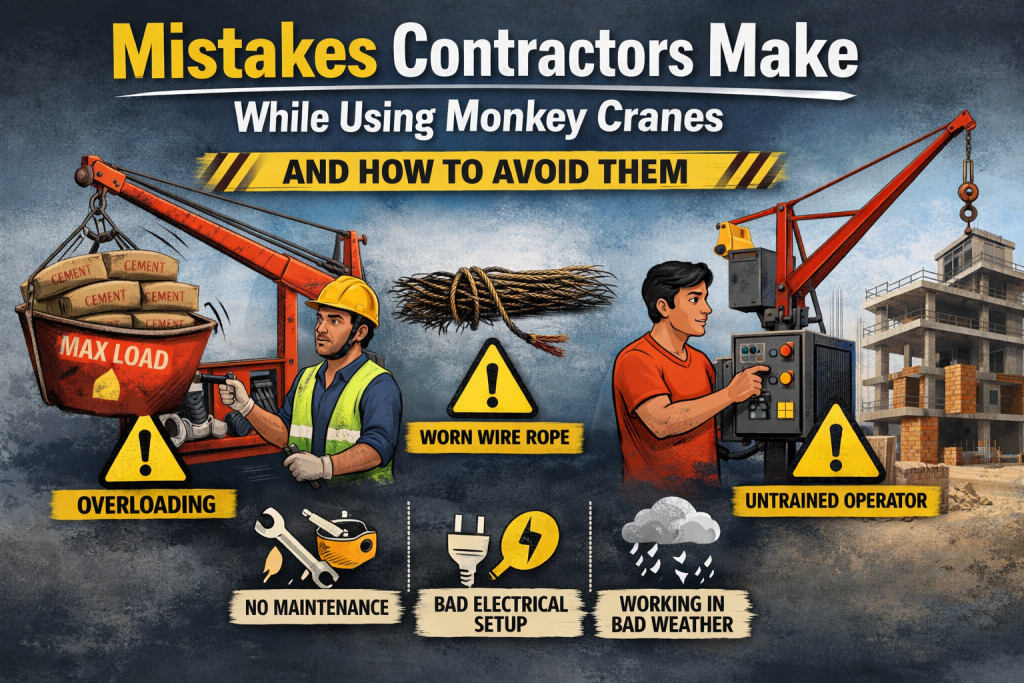
Overloading the Crane Without Realising It
One of the most common problems is overloading. It usually does not happen intentionally. A worker adds one extra cement bag or fills the bucket slightly more to save time.
The issue is that monkey cranes are designed to work within a specific limit. When that limit is crossed repeatedly, even by a small margin, the damage starts slowly. Motors heat up more than they should. Wire ropes stretch faster. Gearboxes begin to make noise.
Many contractors call us saying the crane “suddenly failed”. In reality, it was stressed for weeks.
How to avoid this in practice
- Do not treat load capacity as flexible
- Lift materials in planned quantities, not rushed batches
- Make sure the operator knows the weight being lifted
- Remember that continuous overload reduces machine life far more than people expect
Installing the Crane in a Hurry
Installation mistakes are another major reason for unsafe operation. On many sites, the crane is fixed quickly using whatever support is available at the moment. Alignment checks are skipped because the crane appears to be standing straight.
What happens later is vibration. The crane pulls unevenly, the rope does not wind properly, and stress builds at the mounting point. Over time, bolts loosen and structural support weakens.
What should be done instead
- Always install on a solid, level surface
- Check vertical alignment properly, not by eye judgment
- Use proper mounting hardware, not temporary adjustments
- Recheck installation if the crane is shifted or extended
Ignoring the Condition of the Wire Rope
From a manufacturer’s side, wire rope failure is one of the most dangerous issues we come across. Many sites continue using ropes even after rust appears or strands start breaking.
The logic is usually cost saving. Unfortunately, wire ropes do not fail gradually. When they fail, it is sudden.
Good practice that prevents accidents
- Inspect the rope daily before starting work
- Replace the rope as soon as damage is visible
- Use only load-rated wire ropes meant for lifting
- Avoid jerky lifting that shocks the rope
Replacing a rope early is always cheaper than dealing with an accident.
Letting Anyone Operate the Crane
Monkey cranes look simple, so many sites allow any available worker to operate them. Controls are explained quickly and work continues.
This causes two problems. First, untrained operators tend to jerk loads and overload without noticing. Second, early warning signs like unusual sound or vibration are ignored.
A better approach
- Assign one or two fixed operators
- Explain load limits and basic handling clearly
- Do not rotate operators without instruction
- Encourage operators to report issues instead of hiding them
A trained operator protects both the machine and the people around it.
Running the Crane Without Basic Maintenance
Many contractors believe monkey cranes do not need maintenance until something breaks. In reality, these machines work daily under load, dust, and weather exposure.
Lack of lubrication, loose fasteners, and worn electrical parts slowly reduce efficiency. By the time the crane stops completely, the repair cost is much higher.
Simple habits that help
- Weekly inspection of moving parts
- Regular lubrication where required
- Checking switches, cables, and control panel
- Planned servicing instead of emergency repairs
Maintenance saves time, not wastes it.
Unsafe Electrical Arrangements on Site
Temporary power connections are common on construction sites. Loose wiring, improper earthing, and voltage fluctuation are often ignored.
This affects the motor directly and also creates shock risk for workers, especially during monsoon season.
What should never be ignored
- Proper earthing before operating the crane
- Correct cable size and stable power supply
- Protection of control panels from water and dust
- No open joints near the motor or switch
Electrical safety is as important as mechanical safety.
Operating During Bad Weather
Work pressure sometimes forces lifting even during strong wind or rain. This is risky.
Wind causes suspended loads to swing. Rain affects visibility and electrical safety. Most accidents happen in such conditions.
Safe decision-making
- Stop lifting during high wind
- Avoid operation in heavy rain
- Keep the lifting zone clear
- Maintain clear communication between workers
Delays are easier to manage than accidents.
Choosing the Wrong Crane for the Site
Sometimes the crane itself is not suitable for the job. Selection is done only on price, without checking lifting height, duty cycle, or material type.
This leads to overheating, slow work, and repeated repairs.
Correct selection avoids long-term problems
- Calculate actual lifting height required
- Consider daily working hours and load frequency
- Choose capacity based on real usage, not assumption
- Take guidance from experienced manufacturers
Frequently Asked Questions
What is a monkey crane mainly used for?
Monkey cranes are used for vertical lifting of construction materials such as sand, cement, bricks, and tools on building sites.
Why do monkey cranes fail frequently on some sites?
Failures usually happen due to overloading, poor installation, lack of maintenance, or unsafe electrical connections.
How often should a monkey crane be inspected?
Basic checks should be done weekly, with professional servicing based on usage conditions.
Is wire rope replacement really necessary if it still works?
Yes. Damaged wire ropes are unsafe and should be replaced immediately.
How do I choose the right monkey crane?
Selection should be based on lifting height, load requirement, power supply, and daily usage, not only price.
Conclusion
Monkey cranes are dependable machines when treated correctly. From our experience as manufacturers, most problems do not come from design faults but from small site-level decisions that are repeated daily.
Contractors who focus on proper installation, trained operators, routine checks, and correct selection get smoother work, fewer breakdowns, and safer sites.
At Mathura Crane Industries, we work closely with contractors to provide lifting solutions that match real Indian site conditions, not just specifications on paper.